benjamin aaron advisors · weekly edition
stellar times.
all you need to know about humanity’s journey to the moon, mars, and beyond
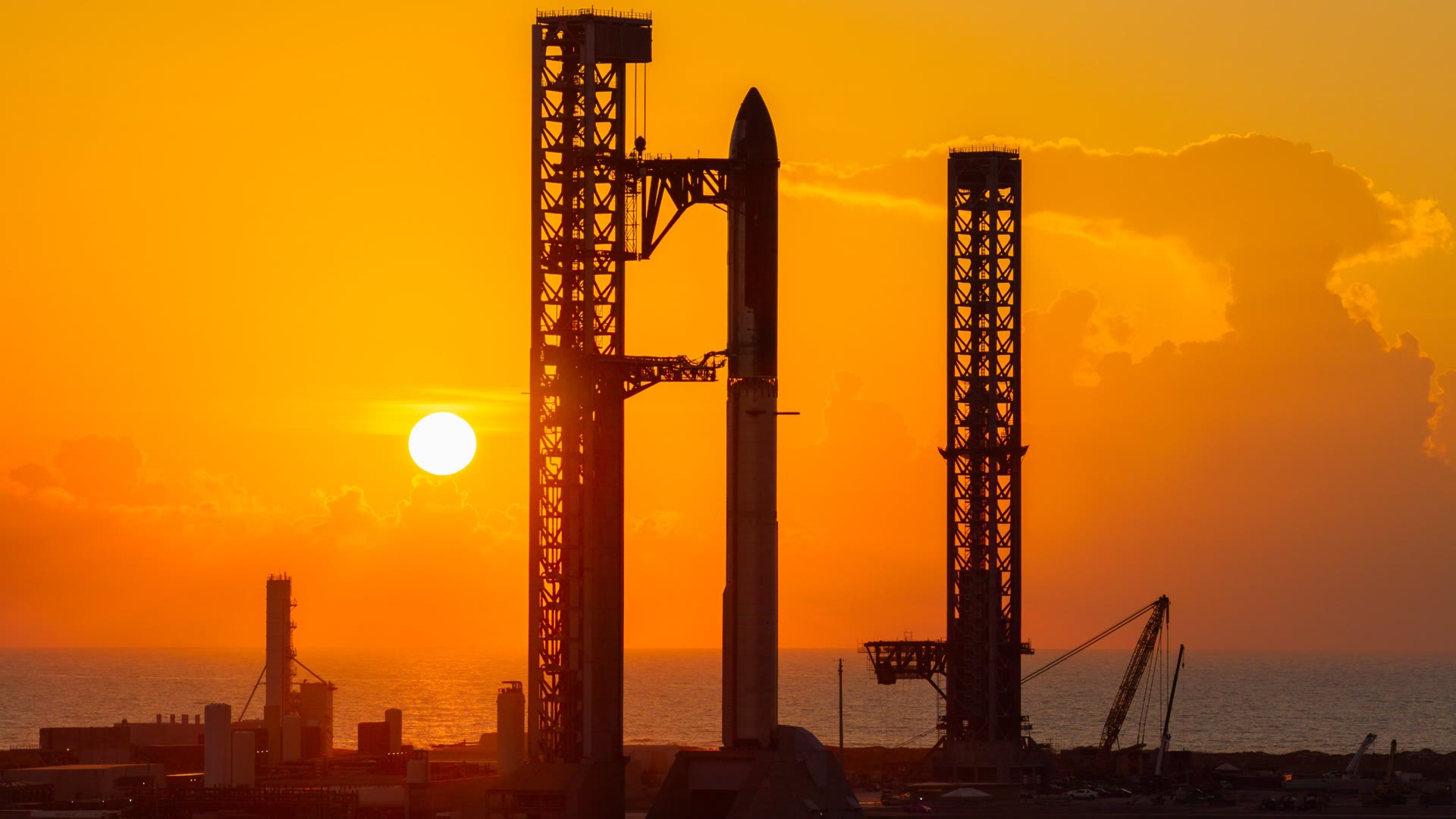
starship reaches orbit and drops off 26 starlink satellites
scrollfront page · starship flight 14
starship made it to orbit even after losing an engine
Ship 41 lost an engine on ascent, coasted through a planned 17-minute check, got a go for orbit, and deployed all 26 Starlink V3 satellites before an early, on-target Pacific splashdown.1
Starship lifted off from Starbase at 7:48 a.m. CT on Monday, Sept. 28, its 14th flight and first orbital attempt. One ship engine shut down early. Engineers confirmed the engines needed for later burns were healthy, and the call came: go for orbit. A single Raptor fired for orbit insertion, a burn Starship had never done, and all 26 satellites deployed over about half an hour.
Because of the engine issue, the team cut the planned six-orbit flight short, flew a first deorbit burn from orbit, and splashed down north of Hawaii at 11:57 a.m. ET. Using Stifel’s method2, a 2 Mbps busy-hour allowance on the roughly 30% of capacity that sits over paying customers, 26 Tbps could serve about 3.9 million subscribers (BAA est.). Starlink’s real-world ratio today points lower, to about 0.4 to 0.5 million. For scale, 26 Tbps is about 1.15% of TeleGeography’s 2,259 Tbps of international internet bandwidth3 (BAA est.). That is backbone capacity, a different thing from satellite downlink, so read it as a size comparison. SpaceX says service starts within a few weeks.
dig infold upthe hold, the burns, the timeline, and what is still open
context
One of the ship’s engines shut down early on ascent, and the webcast briefly said the ship would not reach orbit. Engineers then confirmed the three sea-level Raptors needed for later burns were healthy, and the call came: go for orbit.
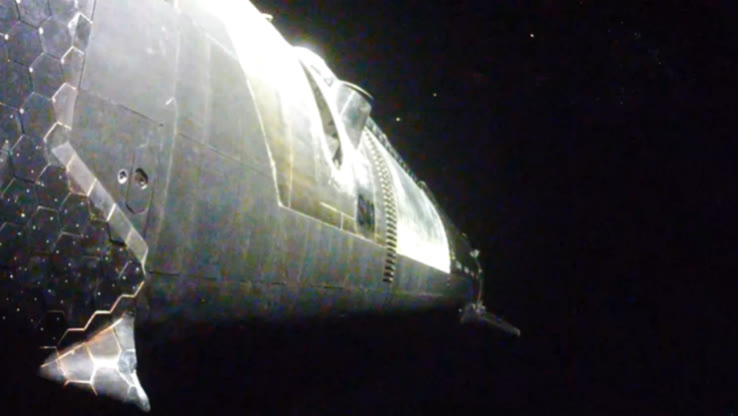
A single sea-level Raptor fired for about 19 seconds for orbit insertion, a burn Starship had never done.4 SpaceQ reports it ran on propellant from the header tank in the nose. Deployment began about 34 minutes after liftoff and ran for roughly half an hour. SpaceX reports contact with every satellite over laser links, ground stations, and user terminals.
“All 26 Starlink V3 operational satellites deployed and operating nominally.”elon musk on x · 09/28/2026
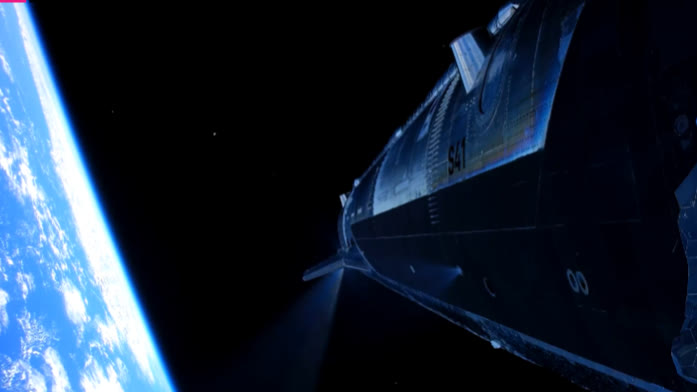
The team cut the planned ~10 hour, six-orbit profile because of the ascent engine issue. The ship flew its first deorbit burn from orbit, then a flip and three-engine landing burn to a splashdown north of Hawaii at 11:57 a.m. ET. As usual for ocean landings, it tipped over and exploded afterward.
why it matters
Flight 14 checked off three firsts for Starship: sustained orbit, an operational payload with contact to all 26 satellites, and a deorbit burn from orbit with an on-target splashdown.
It also reached orbit after an engine loss on ascent, with a go given only once the engines needed for later burns checked out healthy.
the timeline
| 7:48 a.m. CT | liftoff from Starbase, Mon 09/28 (8:48 a.m. ET)SpaceX | SpaceX |
| ~T+25 min | orbit insertion burn, one Raptorreported | reported |
| T+34 min | Starlink V3 deploy startsreported | reported |
| ~T+64 min | deploy ends, all 26 outreported | reported |
| 11:57 a.m. ET | splashdown north of Hawaii, about 3 hours after liftoffreported | reported |
what to watch
- Satellite checkout. The V3s raise their orbits and run checkout. SpaceX says service starts within a few weeks.
- Ship catch at the tower. Open. Not attempted on Flight 14. Polymarket traders put 13% on a catch on Flight 15 (as of 09/30).
- Ship reuse. Open. Not attempted on Flight 14.
- Ship-to-ship propellant transfer. Open. The lunar and Mars dates depend on it.
sources · SpaceX Flight 14 page (09/28) · Spaceflight Now (09/28) · Space.com (09/28) · SpaceQ (09/28) · Ars Technica (09/28) · RTÉ / Reuters (09/28) · Musk on X (09/28) · Polymarket, Starship Flight 15 market
getting to orbit
watch flight 14 go up, drop satellites, and come home
We rebuilt the flight in a physics simulation: gravity, air drag, Earth’s spin, and 33 plus 6 Raptors burning real amounts of propellant. Press a milestone to jump to it.
BAA physics model with rounded public vehicle figures. Liftoff, the orbit burn, the deploy, and splashdown follow reported times; other numbers are model outputs, and geography is illustrative.
dig infold upthe three burns, the math step by step, and how the model works
context
1. Safe path first. The ship’s first burn stops just short of orbit. Its path dips about 25 km below the surface, so if anything failed it would fall back on its own.
2. Go for orbit. After health checks, one sea-level Raptor fires for about 19 seconds. About 91 m/s lifts the low point from about -25 km to roughly 262 km, for an orbit of about 262 by 275 km.
3. Come home. A roughly 100 m/s deorbit burn drops it back into the air. Belly-first through the heat, then a flip and three-engine landing burn.
why it matters
The orbit burn is small, under 1% of the ship’s speed in our model. It is the step that turns a safe suborbital path into an orbit, and SpaceX checked the health of the engines needed for later burns before committing to it.
the math, step by step
| speed to stay in orbit at 275 kmv = √(μ ÷ r) = √(398,600 ÷ 6,646)physics | v = √(μ ÷ r) = √(398,600 ÷ 6,646) | 7.74 km/s | physics |
| one lap of EarthT = 2π √(r³ ÷ μ)physics | T = 2π √(r³ ÷ μ) | ~90 minutes | physics |
| booster’s share of the job~5,800 km/h at staging (T+2:22) ÷ orbital speedBAA model | ~5,800 km/h at staging (T+2:22) ÷ orbital speed | ~21% of orbital speed | BAA model |
| rocket equation, both stagesΔv = Isp × g × ln(full ÷ empty)BAA model | Δv = Isp × g × ln(full ÷ empty) | ~3.0 + ~6.1 ≈ 9.1 km/s | BAA model |
| lost to gravity and air9.1 − (7.74 − 0.42 from Earth’s spin)BAA model | 9.1 − (7.74 − 0.42 from Earth’s spin) | ~1.8 km/s | BAA model |
| max-Q, peak air pressureq = ½ ρ v²BAA model | q = ½ ρ v² | ~27.6 kPa at T+0:54 (BAA model; SpaceX planned T+0:58) | BAA model |
| the orbit burn19 s on one Raptor, low point from about -25 to about +262 kmArs Technica | 19 s on one Raptor, low point from about -25 to about +262 km | ~91 m/s, a little over 1% of speed | Ars Technica |
| the deorbit burndrop low point to -48 kmBAA model | drop low point to -48 km | ~100 m/s | BAA model |
| hardest part of reentrypeak heating ∝ √ρ × v³BAA model | peak heating ∝ √ρ × v³ | ~76 km, ~24,275 km/h, ~1.9 g | BAA model |
BAA physics model: a two-dimensional simulation in 0.1 second steps with inverse-square gravity, an exponential atmosphere, Earth’s rotation, and engine thrust that rises as the air thins. Vehicle figures are rounded public estimates (about 4,180 t booster and 1,810 t ship fueled, 26 V3s at about 2 t each). Liftoff, the ~T+25 minute orbit burn, the T+34 to 64 minute deploy, and the 11:57 a.m. ET splashdown follow reported times. Other times and numbers are model outputs. The ground track is a flat slice, so geography is illustrative.
sources · BAA physics model (09/2026) · reported event times: SpaceX Flight 14 page (09/28) · Spaceflight Now (09/28) · Space.com (09/28)
starlink v3
this starship launch added about as much internet as ten falcon 9s
Each V3 is designed for 1 Tbps down (company target)5, enough for about 150,000 subscribers using Stifel’s method (BAA est.). SpaceX puts this launch at about ten Falcon 9 launches of the older V2 Mini (company figure). Our check agrees: a Falcon 9 load of V2 Mini adds about 2.3 to 2.8 Tbps, so 26 Tbps is about 9 to 11 Falcon 9s (BAA est.). A full Starship is planned to carry up to 60, which SpaceX says adds more than 20 times the capacity of a Falcon 9 launch (company target).
Those are design numbers. Each satellite still has to raise its orbit and pass checkout. Stifel’s 30% already takes out oceans and empty land, so treat 3.9 million subscribers as an upper estimate, with about 0.4 to 0.5 million as the real-world check.
dig infold uphow a v3 moves data, how we turn terabits into people, and the caveats
context
Each V3 is designed for 1 Tbps down. Flight 14’s 26 satellites carry roughly 26 Tbps of design downlink, and a fully loaded Starship is planned to carry up to 60 V3s. Tesla Oracle put Flight 14’s addition at about 3% of the whole constellation’s capacity, 26 Tbps on top of about 841 Tbps6. Starpath’s math lands in the same place, at about 0.11% of network capacity per V3. Both imply a network of roughly 870 to 910 Tbps; our dazzling data model puts it lower, about 735 Tbps (BAA est.).
How a V3 moves your data. Phased array antennas steer 2,048 downlink and 2,048 uplink beams electronically, with no moving dish. V2 had 192 and 144. Six optical links at 400 Gbps each pass traffic from satellite to satellite, so data can cross an ocean without touching the ground. About 1.2 Tbps of radio links across Ka, E, V, and W bands connect to ground gateways and the wider internet.
How we turn terabits into people. Networks sell 100 Mbps plans and plan for far less per home at the busiest hour, because not everyone streams at once. Stifel uses 2 Mbps per subscriber, a 50:1 ratio, and applies it only to sellable capacity: about 30% of the total once oceans, empty land, and closed markets come out. 1 Tbps × 30% ÷ 2 Mbps is 150,000. The same math on 26 Tbps gives about 3.9 million. As a check, Starlink’s actual ratio today, about 12 million subscribers7 on roughly 735 Tbps of design capacity, works out to 16,000 to 18,000 subscribers per Tbps, or about 0.4 to 0.5 million for this launch.
why it matters
This partial load of 26 moved about as much bandwidth as ten Falcon 9 launches of the older V2 Mini, per SpaceX. Our own math gives 9 to 11 (BAA est.). A full load of 60 adds more than 20 times a Falcon 9 launch, per SpaceX. Starlink capacity growth now rides on how often Starship flies. Reuters reports analysts see each batch worth hundreds of millions of dollars in projected revenue.
engineering and operations
Replacement cadence. Starlink satellites last about five years. Roughly 10,500 working broadband satellites (McDowell, 09/28)8 means about 2,100 a year wear out, which is about 80 Falcon 9 launches a year just to stand still (BAA est.). A 3,500-satellite V3 fleet would need about 700 replacements a year, or about 12 full Starship launches a year before any growth (BAA est.).
Ground stations and backhaul. A satellite can only deliver what it can hand off. Each V3 carries about 1.2 Tbps of gateway radio links plus lasers, so traffic over the ocean rides the laser mesh to a gateway. Gateway sites, fiber, and a license in each country set where the capacity is usable.
Spectrum and beams. 1 Tbps is the total across 2,048 beams, about 490 Mbps per beam on average. At 2 Mbps busy-hour, one fully loaded beam carries roughly 245 active homes. Dense towns fill their beams long before the satellite runs out, and interference limits that protect other satellites cap how hard each beam can be pushed.
Oversubscription. The 50:1 ratio holds only while busy-hour use stays near 2 Mbps a home. Household traffic grows about 20 to 30% a year. At 3 Mbps, the 3.9 million becomes about 2.6 million (BAA est.).
Supply chain and failure modes. Sixty V3s per Starship means building phased arrays, lasers, and solar arrays at a much higher rate. A single Starship also concentrates risk: losing one full load is about 60 Tbps, against about 2.6 Tbps for a Falcon 9. Expect a few satellites per batch to fail checkout or deorbit early.
the numbers
| 1 Tbps | design downlink per V3 satellitecompany target | company target |
| ~26 Tbps | Flight 14, 26 V3scompany target | company target |
| ~60 Tbps | a full Starship, 60 V3scompany target | company target |
| 2.3 to 2.8 Tbps | one Falcon 9 load of V2 Mini: 24 to 29 satellites × 96 GbpsBAA est. | BAA est. |
| ~10× | this launch vs one Falcon 9 launch of V2 Mini, per SpaceX’s Flight 14 pagecompany target | company target |
| 9 to 11 | BAA check on the same comparison: 26 Tbps ÷ 2.3 to 2.8 TbpsBAA est. | BAA est. |
| >20× | a full 60-V3 Starship vs one Falcon 9 V2 Mini launchcompany target | company target |
| 2,048 | downlink beams per V3, vs 192 on V2 (Starpath, Converge Digest)company target | company target |
| 6 × 400 Gbps | laser links per V3company target | company target |
| ~150,000 | subscribers per V3: 1 Tbps × 30% sellable ÷ 2 Mbps busy-hourBAA est. | BAA est. |
| ~3.9M | subscribers for Flight 14, same method: 26 Tbps × 30% ÷ 2 MbpsBAA est. | BAA est. |
| ~0.4 to 0.5M | real-world check: about 12M subscribers on roughly 735 Tbps, applied to 26 TbpsBAA est. | BAA est. |
| 2,259 Tbps | international internet bandwidth, mid-2026 (TeleGeography)verified | verified |
| ~1.15% | 26 Tbps vs 2,259 Tbps, for scale only: backbone capacity, not satellite downlinkBAA est. | BAA est. |
| 8,000+ Tbps | used international bandwidth, 2025, including private cloud networks (TeleGeography)verified | verified |
| ~0.3% | 26 Tbps vs 8,000+ Tbps, for scale onlyBAA est. | BAA est. |
what to watch
- Checkout. Each satellite still has to unfold antennas and arrays, link up by radio and laser, raise and circularize its orbit, and pass checkout. SpaceX says service starts within a few weeks.
- Real service. It depends on where the satellites sit, ground gateways, and demand. Satellites spend much of each orbit over oceans and empty land, so even 3.9 million subscribers is an upper estimate.
- Subscriber count. Kalshi traders put 58% on SpaceX reporting more than 14.5 million active Starlink subscribers for Q3 2026, in thin trading (as of 09/30).
sources · SpaceX Flight 14 page (09/28) · Starpath (09/28) · Converge Digest (09/28) · Light Reading (09/28) · Tesla Oracle (09/30) · McDowell, Starlink statistics (09/28) · Reuters (09/28) · TeleGeography (2025, 2026) · Stifel, Satcoms Muskonomics (06/2024) · Starlink on X and SpaceX 2024 Progress Report (V3 vs Falcon 9) · SpaceX Q2 2026 results (subscribers) · Kalshi, Starlink subscribers market
ai · compute
anthropic nearly doubles its spacex ai deal to $84.5b and can exit on 90 days notice
Up to $84.5B through 2029 for Nvidia-based compute, most of it cancelable on 90 days notice.
Anthropic expects to spend at least $518B over ten years on AI infrastructure with six partners, about 80% of it owed regardless of use, according to its confidential IPO prospectus as reported by Reuters on Sept. 29. The SpaceX deal is the flexible one: up to $84.5B, up from about $45B, and most of it can be ended with 90 days notice. SpaceX’s own filing says the $1.25B a month covers about 325,000 Nvidia GPUs across Colossus 1 and Colossus 2, about $5.27 per GPU-hour (BAA est.). Walking away means about three more months of fees: roughly $3.75B at the old $1.25B a month, or about $7.0B if the new $84.5B ceiling runs over the same three years (BAA est.).
dig infold upthe filing, the partners, what the rent works out to, and the exit cost
context
The figures come from Anthropic’s confidential IPO prospectus as reported by Reuters on Sept. 29. Anthropic expects to spend at least $518B over ten years on AI infrastructure with six partners. About 80% of that is non-cancelable or owed regardless of use.
SpaceX’s own IPO paperwork had described about $45B, or $1.25B a month for three years. The new figure is up to $84.5B, and most of it can be ended with 90 days written notice. The capacity traces to May 2026, when Anthropic took exclusive use of Colossus 1, a SpaceX facility with more than 220,000 Nvidia GPUs on over 300 MW. In June Anthropic also began scaling GB200 capacity on Colossus 2. SpaceX’s S-1/A says the monthly fee covers about 325,000 GPUs across both sites. SPCX shares were up about 2.4% by midday Sept. 29, with TD Cowen also starting coverage at buy that morning9.
How a compute lease works. A data center packs GPUs, power, and cooling. The AI lab pays a monthly rate for reserved capacity, used for training models or for inference, meaning answering users. Take-or-pay deals bill the full amount no matter what. A 90-day cancel clause lets the renter walk with a quarter’s notice.
why it matters
Most of Anthropic’s $518B plan is take-or-pay. The SpaceX line is the flexible piece: it is largely cancelable on a quarter’s notice, so it is the commitment that can shrink fastest.
engineering and operations
Power and cooling. An H100 or H200 board draws about 700 W. A full 8-GPU server draws about 10.2 kW, or about 1.3 kW per GPU, and GB200 racks run about 1.7 to 1.8 kW per GPU. SpaceX’s filing lists about 100,000 H100 at about 130 MW, plus about 110,000 GB200 at about 210 MW and 110,000 GB300 at about 220 MW. That is about 1.3 kW per H100 and about 2 kW per GB200 or GB300, the same as the server math, so the filing’s megawatts read as IT load. Across the roughly 325,000 GPUs that is about 560 MW of IT load. With a PUE of 1.2 to 1.3, meaning cooling and power losses add 20 to 30%, the meters read roughly 670 to 730 MW (BAA est.).
Getting the power. Memphis runs on a mix of grid power from MLGW, which buys from TVA, plus on-site gas turbines and Megapack batteries11. Each extra 150 MW of grid power needs a TVA board vote, since any new load over 100 MW does10, and the substations and transmission work behind it take time.
Failure modes. At about 325,000 GPUs across two sites, failed GPUs, memory, and network links are a daily event. Inference shrugs off a lost server more easily than a training run does. A cooling or power fault takes out a block of megawatts at once, which is why the cooling plant gets the redundancy.
commitments by partner, and the math
| $161.2B | Broadcom, equipment leasesverified · Reuters | verified · Reuters |
| $111.1B | Googleverified · Reuters | verified · Reuters |
| $110.0B | Amazonverified · Reuters | verified · Reuters |
| up to $84.5B | SpaceX / xAI compute, largely cancelable on 90 days noticeverified · Reuters | verified · Reuters |
| $31.4B | Microsoftverified · Reuters | verified · Reuters |
| >$20B | AMD, computing capacity, plus up to $5B of Anthropic stock. The six together come to about $518Bverified · Reuters | verified · Reuters |
| $1.25B a month | the old deal: $45B ÷ 36 monthsverified · SpaceX IPO filing | verified · SpaceX IPO filing |
| 1.9x | the new ceiling vs the old: $84.5B ÷ $45BBAA est. | BAA est. |
| ~$5.27 | rent per GPU-hour: $1.25B ÷ about 325,000 GPUs across Colossus 1 and 2 (SpaceX S-1/A) ÷ 730 hoursBAA est. | BAA est. |
| ~1.3 to 2.0 kW | IT power per GPU in SpaceX’s filing: about 1.3 kW per H100, about 1.9 kW per GB200, about 2.0 kW per GB300, before cooling. Colossus 1’s reported 300 MW ÷ 220,000 GPUs gives about 1.4 kW, in the same rangeverified · SpaceX S-1/A | verified · SpaceX S-1/A |
| ~560 MW | IT load for the leased GPUs: about 130 + 210 + 220 MW from the filingBAA est. | BAA est. |
| ~$27M | rent per MW of IT load a year: $1.25B × 12 ÷ about 560 MWBAA est. | BAA est. |
| ~$3.75B to ~$7.0B | fees during the 90-day notice period: 3 × $1.25B at the old rate, or 3 × ($84.5B ÷ 36) at the new ceilingBAA est. | BAA est. |
| ~$414B | non-cancelable or owed regardless of use: 80% × $518BBAA est. | BAA est. |
| ~$52B a year | spend across all partners: $518B ÷ 10 yearsBAA est. | BAA est. |
SpaceX’s own filing (S-1/A, 06/03/2026) says the fee covers about 325,000 GPUs across Colossus 1 and 2, which works out to about $5.27 an hour. Per-MW rent uses the filing’s compute power, which is IT load before cooling. Real pricing per GPU type is not public, so treat these as a sense of scale. 730 is the average hours in a month. Reuters cites six partners, all six listed here.
what to watch
- The 90-day cancel clause. Walking away means about three more months of fees: roughly $3.75B at the old rate, or about $7.0B at the new ceiling (BAA est.).
- The filing itself. These numbers come from a confidential prospectus seen by Reuters, not a public document.
- The IPO date. Kalshi traders put 80% on Anthropic officially announcing an IPO before Jan. 1, 2027 (as of 09/30). Polymarket traders put 81% on an IPO by Dec. 31, 2026 (as of 09/30).
sources · Reuters via Investing.com (09/29) · The Information via Techmeme (09/29) · Stocktwits (09/29) · Crypto Briefing (09/29) · SpaceX IPO filing via The Deep Dive (05/20) · Tom Brown on X, Colossus 2 (05/20) · Epoch AI and BEP Research (Colossus 1 hardware and power) · SpaceX S-1/A No. 2 (06/03/2026) · Reuters via The Globe and Mail, AMD (09/29) · Kalshi, Anthropic IPO market · Polymarket, Anthropic IPO market
tesla · spacex
tesla and spacex keep getting closer, with no merger filed
Musk and Gwynne Shotwell keep describing more overlap between the companies, and neither has announced or filed a merger agreement. On Sept. 29, SEC staff cleared Tesla’s voluntary retail voting program, which lets holders opt into voting with the board, with or without mergers carved out. The real signals to watch are a proxy filing, a special committee, or a definitive agreement. Prediction markets put a signed merger agreement before 2027 at 24% and before 2028 at 78% (Kalshi, as of 09/30).
dig infold upwhat musk and shotwell said, how the new voting option works, and the market odds
context
At the All-In Summit on Sept. 15, asked why Tesla and SpaceX stay separate, Musk said:
“With all this collaboration, on so many levels, who can imagine what action one might take when there’s so much close collaboration in so many areas.”elon musk · all-in summit · 09/15/2026
Gwynne Shotwell said the businesses are integrating “faster than I thought.” On the July 22 Tesla call, Musk described “more and more overlap” and said any combination needs “the appropriate process.” Neither company has announced or filed a merger agreement.
How Tesla’s new voting option works. SEC staff issued a no-action letter on Sept. 29 for Tesla’s voluntary retail voting program12. Retail holders can opt into a standing instruction to vote with the board, on all matters or on all except contested director elections and mergers. It is free, can be overridden per proposal or canceled anytime, and comes with an annual reminder. Other issuers can use the same framework.
why it matters
The SEC letter does not mention SpaceX. Its effect on any future deal depends on how many holders pick “all matters” over the version that carves out mergers.
market odds and the merger math
| 24% | signed Tesla and SpaceX merger agreement before Jan. 1, 2027Kalshi · as of 09/30 | Kalshi · as of 09/30 |
| 78% | signed merger agreement before Jan. 1, 2028Kalshi · as of 09/30 | Kalshi · as of 09/30 |
| 19% | merger officially announced by Dec. 31, 2026Polymarket · as of 09/30 | Polymarket · as of 09/30 |
| 63% | merger officially announced by Dec. 31, 2027Polymarket · as of 09/30 | Polymarket · as of 09/30 |
| ~39.0% | premium needed for a $2T Tesla value (CEO award tranche 1)FinanceFeeds est. | FinanceFeeds est. |
| ~39.9% | premium at which Tesla holders own 50% of the combined companyFinanceFeeds est. | FinanceFeeds est. |
Market odds are yes prices: the midpoint of the bid and ask, or the last trade when the spread is wider than 10 cents. Polymarket rows update live on this page. Kalshi rows are saved as of 09/30/2026, 5:05 p.m. ET. Odds move daily and replace the older secondhand odds in our draft. The two premium thresholds sit about one point apart. FinanceFeeds calculation, Sept. 2026. Estimate only.
what to watch
- A proxy filing.
- A special committee.
- A definitive merger agreement.
sources · Sullivan & Cromwell (09/29) · Bloomberg Law (09/29) · Electrek (09/29) · All-In Summit (09/15) · FinanceFeeds (09/2026) · IBTimes UK (09/2026) · Kalshi, Tesla and SpaceX merger market · Polymarket, Tesla and SpaceX merger market
the next few weeks
what’s launching next
| thu 10/01 | Crew-13 to the ISS, 11:10 a.m. ET. SpaceX target. |
| mon 10/19 | H3 · MMX, JAXA’s mission to the Martian moon Phobos, 3:41 p.m. ET (10/20 in Japan)13. Target. |
| october | Starlink V3 checkout, then service within a few weeks. SpaceX. |
| tbd | Starship Flight 15. No SpaceX date yet. Kalshi traders put 46% on a launch before Oct. 30 (as of 10/01, 12:12 a.m. ET). |
| mid-2027 | Artemis III, crewed Orion docking practice with one or both commercial landers in Earth orbit14. NASA target. |
dig infold upthe full calendar, flight 15 and its market odds, and one environmental finding
context
Starship Flight 15. SpaceX has not given a date. An Oct. 19 FAA air traffic planning date was reported, and trackers now show TBD; T-Minus Zero shows December 2026, day TBD15, and Next Spaceflight lists no earlier than October 202616. Ship 42 and Booster 22 are assigned. Musk said the first attempt to catch the ship with the tower arms comes on Flight 15 if Flight 14 went well. The catch needs a full-duration flight and FAA approval.
What the markets say about Flight 15. Kalshi traders put 46% on Flight 15 launching before Oct. 30 and 74% before Nov. 13 (as of 10/01, 12:12 a.m. ET). Polymarket traders put 13% on the tower arms catching the ship on Flight 15 (as of 09/30). Musk has said the odds of catching the ship on the first attempt are at least 50 or 60 percent17.
Also this week. The Federal Register published a Finding of No Significant Impact for Relativity’s Terran R at Cape Canaveral on Sept. 28. A FONSI is an environmental finding, not a launch license.
the full calendar
| thu 10/01 | Crew-13 to the ISS, 11:10 a.m. ETSpaceX target | SpaceX target |
| thu 10/01 | Transporter 18 rideshare, VandenbergTarget | Target |
| mon 10/05 | SDA Tranche 1 Transport Layer A, military data relay satellites, 4:16 a.m. ET (08:16 UTC)18Target | Target |
| mon 10/19 | H3 · Martian Moons eXploration (MMX), JAXA’s mission to Phobos, 3:41 p.m. ET (10/20 in Japan)13Target | Target |
| october | Starlink V3 checkout and orbit raising, then service within a few weeksSpaceX | SpaceX |
| tbd | Starship Flight 15. No SpaceX dateno date | no date |
| by 12/31 | New Glenn return to flight after the May 28 pad explosionCompany target | Company target |
| mid-2027 | Artemis III, crewed Orion docks with one or both commercial landers in Earth orbit, no landing14NASA target | NASA target |
| 2028 | Artemis IV, the first Artemis crewed landing. Lander provider not yet chosenNASA target | NASA target |
what to watch
- A SpaceX date for Flight 15. The Oct. 19 date is an FAA air traffic planning date, not a SpaceX announcement.
- Crew-13 on Thursday, and the V3 checkout through October.
sources · launch calendars: UchUchU, SpaceNexus (10/2026) · Next Spaceflight (Flight 15) · T-Minus Zero (Flight 15) · Gizmodo, citing the FAA planning date (09/29) · Musk on a Flight 15 catch attempt, via Investing News · Blue Origin, Space.com (New Glenn) · Federal Register (09/28) · NASA Artemis · NASA Artemis architecture update · Kalshi, Starship Flight 15 launch market · Polymarket, Starship Flight 15 market
the last word · every week
ben’s countdown to mars
Our better-than-nothing guess at when a person first stands on Mars, and every step that has to happen first.
| # | milestone and what it proves | date | countdown | BAA odds |
|---|---|---|---|---|
| 01 | Booster caught by the launch tower10/13/2024Super Heavy can come home and be reused fast. SpaceX Flight 5.launches: 1 | 10/13/2024 | ✓ | done |
| 02 | Raptor engine relit in space11/19/2024The ship can fire its engines on command in orbit, needed for every deorbit and transfer burn. SpaceX Flight 6.launches: 1 | 11/19/2024 | ✓ | done |
| 03 | A flown booster flies again05/27/2025Boosters are reusable hardware, not throwaway stages. SpaceX Flight 9.launches: 1 | 05/27/2025 | ✓ | done |
| 04 | First orbital Starship and first V3s delivered to orbit09/28/2026The ship can reach orbit, do real work, and come back on target. SpaceX Flight 14.launches: 1 | 09/28/2026 | ✓ | done |
| 05 | Ship caught by the launch tower03/20/2027The upper stage can come back whole, so it can fly again. BAA est..launches: 2 to 3 more test flights first | 03/20/2027 | 172 days | low |
| 06 | First tanker Starship flies05/20/2027A stripped-down ship built only to carry propellant, the workhorse of every refill. BAA est..launches: 1 | 05/20/2027 | 233 days | low |
| 07 | Artemis III: crewed Orion docks with one or both commercial landers in Earth orbit1406/30/2027People and Starship working together in space. NASA target mid-2027.launches: one or both commercial landers plus NASA's SLS rocket | 06/30/2027 | 274 days | medium |
| 08 | A caught ship flies again08/15/2027Both stages reused, which is what makes dozens of tanker flights affordable. BAA est..launches: 1 | 08/15/2027 | 320 days | low |
| 09 | Ship-to-ship propellant transfer in orbit10/15/2027Two ships dock and move super-cold propellant, the key that unlocks both the Moon and Mars. BAA est..launches: 2, a few days apart | 10/15/2027 | 381 days | low |
| 10 | Starship launching about weekly from Texas and Florida01/15/2028Refilling needs many launches in a short span, so two coasts and fast pad turnaround matter. BAA est..launches: about 4 a month | 01/15/2028 | 473 days | low |
| 11 | Propellant kept cold in orbit for weeks03/01/2028Boil-off is under control, so fuel waits in orbit while the next tankers arrive. BAA est..launches: 1 to 2 | 03/01/2028 | 519 days | low |
| 12 | Orbital depot filled by a string of tankers06/15/2028A gas station in orbit that can top off a Moon or Mars ship. BAA est..launches: about 10+ tankers in roughly 6 weeks (BAA est.) | 06/15/2028 | 625 days | low |
| 13 | First uncrewed Starship landing on the Moon10/15/2028Landing a Starship on another world after refilling in orbit. BAA est..launches: 1 lander plus about 10+ tankers | 10/15/2028 | 747 days | low |
| 14 | First uncrewed Starships launch for Mars12/15/2028Hitting a Mars launch window with several fully refilled ships. BAA est. (late-2028 window).launches: 2 to 4 ships, each needing several tanker flights | 12/15/2028 | 808 days | low |
| 15 | First Starship lands on Mars07/15/2029Entry, descent, and landing in thin Martian air. BAA est. (~7-month trip).launches: 0 (already on the way) | 07/15/2029 | 1,020 days | low |
| 16 | First crew lands on the Moon in a Starship11/15/2029Starship can carry people down to another world and back up. BAA est..launches: 1 lander, 1 crew rocket, about 10+ tankers | 11/15/2029 | 1,143 days | low |
| 17 | Second Mars wave: power, propellant plant, and more cargo launch02/20/2031Sending the factory that makes the fuel home. BAA est. (early-2031 window).launches: about 4+ ships and dozens of tankers | 02/20/2031 | 1,605 days | low |
| 18 | Power and propellant-plant hardware lands on Mars09/15/2031The hardware survives landing and can be set up without people. BAA est..launches: 0 (already on the way) | 09/15/2031 | 1,812 days | low |
| 19 | First rocket propellant made on Mars08/01/2032Methane and oxygen from Martian CO2 and ice, so a ship can fly home. BAA est..launches: 0 | 08/01/2032 | 2,133 days | low |
| 20 | Third Mars wave: habitats, spare ships, and supplies launch04/20/2033Everything the first crew needs is waiting before they leave. BAA est. (spring-2033 window).launches: about 4+ ships and dozens of tankers | 04/20/2033 | 2,395 days | low |
| 21 | Crew lives aboard a Starship in Earth orbit for months06/01/2034Life support, radiation shelter, and health hold up for a trip-length stay. BAA est..launches: 1 to 2 plus tankers | 06/01/2034 | 2,802 days | low |
| 22 | First crew launches for Mars07/10/2035People leave Earth on a fully refilled ship. BAA est. (mid-2035 window).launches: crew ship plus cargo ships and dozens of tankers | 07/10/2035 | 3,206 days | low |
| 23 | First human steps onto Mars01/20/2036The whole chain works end to end. BAA est. (~6-month trip).launches: 0 (already on the way) | 01/20/2036 | 3,400 days | low |
moved this week: first human now 01/20/2036, plus 5 other dates. Tap for why.
- First human on Mars moved from 09/12/2033 to 01/20/2036. Once we listed every step (ship catch and reflight, a tanker ship, a filled depot, weeks of cold storage, and a working fuel plant on Mars), they did not fit before the spring-2033 window, so the first crew moves to the mid-2035 window.
- First crew launch moved from 04/12/2033 to 07/10/2035 for the same reason.
- Ship-to-ship propellant transfer moved from 12/18/2026 to 10/15/2027, after a tanker version of the ship has flown.
- Ship catch moved from 02/15/2027 to 03/20/2027, allowing 2 to 3 more test flights first.
- Uncrewed Moon landing moved from 03/15/2027 to 10/15/2028, after a depot can be filled.
- First Mars cargo launch moved from 11/07/2028 to 12/15/2028 to sit inside the late-2028 window; first Mars landing moved from 06/05/2029 to 07/15/2029 to match.
How to read it: dates marked BAA est. are our own guesses, not SpaceX or NASA commitments. The BAA odds tag is our confidence that the date holds within about three months. Mars dates follow real launch windows, which open about every 26 months (late 2028, early 2031, spring 2033, mid 2035), so a slip usually costs about two years, not a few weeks. The late-2026 window is open right now, about Oct. 6 to Dec. 2, 2026 (BAA est.), and we skip it because no ship has been refilled in orbit yet. The launches line is our rough count of flights each step needs; one Mars ship alone needs several tanker flights to refill before it can leave Earth orbit. Almost everything after Flight 14 depends on refilling ships in orbit, which has not been done yet. The operations problem is cadence: propellant boils off in orbit, so the tankers for one Mars ship have to fly within weeks of each other, which is why weekly launches from two coasts sits on this list.
what prediction markets say
| milestone | market odds |
|---|---|
| Ship caught by the launch towerBAA est. 03/20/2027 | 13% polymarket the tower catches the ship on Flight 15 (as of 09/30) |
| Ship-to-ship propellant transferBAA est. 10/15/2027 | 51% kalshi two Starships dock in orbit before 2028, a step toward transfer (as of 09/30) 43% polymarket two Starships dock by Dec. 31, 2027 (as of 09/30) |
| First uncrewed Starship landing on the MoonBAA est. 10/15/2028 | 63% kalshi Blue Origin lands an uncrewed Blue Moon MK1 before SpaceX lands an uncrewed Starship, before 2030 (as of 09/30) 25% manifold an uncrewed Starship lander touches down in 2028 (as of 09/30) |
| First Starship lands on MarsBAA est. 07/15/2029 | 26% kalshi SpaceX lands anything on Mars before 2030 (as of 09/30) 12% manifold Starship lands on Mars before 2030 (as of 09/30) |
| First crew lands on the Moon in a StarshipBAA est. 11/15/2029 | 42% kalshi a NASA crew lands on the Moon before 2030, any lander (as of 09/30) 26% kalshi a NASA crew lands before 2029 (as of 09/30) 39% manifold Starship lands the next crew on the Moon, before anyone else (as of 09/30) |
| First human steps onto MarsBAA est. 01/20/2036 | 12% kalshi a crewed Starship launches for Mars before 2030 (as of 09/30) 18% manifold a SpaceX mission lands people on Mars before 2040 (as of 09/30) |
Polymarket and Manifold (play money) prices update live on this page about every five minutes, marked live with the time of the last update. Kalshi prices are saved as of 09/30/2026, 5:05 p.m. ET (the Flight 15 launch-date prices as of 10/01, 12:12 a.m. ET), because Kalshi does not allow its public prices to be loaded from other websites. If a live feed fails, the saved 09/30 price stays and is marked with that date. Prices are the midpoint of the yes bid and ask, or the last trade when the spread is wider than 10 cents, and the market probability on Manifold. Each market asks a slightly different question from our milestone, so read it next to the BAA date. The BAA odds column above is our own confidence that a date holds within about three months, and is labeled BAA.
sources
- spaceflight now · starship returns to earth after three-hour flight · 09/28/2026 · link ↩
- stifel · satcoms’ muskonomics challenge (2 mbps per subscriber on ~30% sellable capacity) · 06/2024 · link ↩
- telegeography · international internet bandwidth now totals 2,259 tbps · 09/21/2026 · link ↩
- ars technica · starship’s first orbital launch gives lift to spacex’s next-gen starlinks · 09/28/2026 · link ↩
- starlink · progress 2024 (v3 designed for 1 tbps down) · 12/2024 · link ↩
- tesla oracle · 26 tbps of starlink v3 bandwidth in a single starship launch (841.5 tbps before, about 3% added) · 09/30/2026 · link ↩
- spacex · q2 2026 results (12.0m starlink subscribers at 06/30/2026) · 08/04/2026 · link ↩
- jonathan mcdowell · starlink statistics (about 10,500 working broadband satellites) · 09/28/2026 · link ↩
- benzinga · spacex stock rises tuesday (spcx up 2.39% midday, td cowen buy) · 09/29/2026 · link ↩
- wreg · tva oks additional 150 mw of electricity for xai memphis data center · 02/12/2026 · link ↩
- suedatacenters.org registry · colossus, memphis (grid substation, on-site gas turbines, megapack storage) · 09/10/2026 · link ↩
- sullivan & cromwell · sec issues broad relief for retail voting programs · 09/29/2026 · link ↩
- jaxa · mmx launch on h3 f10 (10/20/2026 04:41 jst) · 08/20/2026 · link ↩ ↩
- nasa · artemis architecture update (artemis iii docks with one or both commercial landers) · 2026 · link ↩ ↩ ↩
- t-minus zero · starship launch schedule (flight 15: december 2026, tbd) · 09/30/2026 · link ↩
- next spaceflight · starship flight 15 · 09/2026 · link ↩
- investing news · musk puts catch odds at 50 or 60 percent · 09/2026 · link ↩
- orbit codex · sda tranche 1 transport layer a, falcon 9 (10/05 08:16 utc) · 10/01/2026 · link ↩
more sources and notes · SpaceX Flight 14 page (09/28) · Spaceflight Now (09/28) · Space.com (09/28) · Reuters (09/28, 09/29) · TeleGeography (2026) · Stifel, Satcoms Muskonomics (06/2024) · Starlink on X (12/31/2024) · SpaceX Q2 2026 results · Sullivan & Cromwell, Bloomberg Law (09/29) · launch calendars (10/2026). Kalshi market prices (09/30, 5:05 p.m. ET; Flight 15 launch dates 10/01, 12:12 a.m. ET); Polymarket and Manifold prices (live, saved 09/30 fallback). Photos: SpaceX. Flight animation: BAA physics model. Countdown dates: BAA estimates except where marked. BAA estimates are labeled.