short summary. this is the weekly roundup of the biggest space moves. both flight 15 stages have now fired their engines on the ground, so the first try at catching a ship and a booster only waits on the faa. google's test data center satellite is online and wrote its first haiku. falcon 9 flew for the 700th time. the artemis iii rocket is joined up, and japan's mmx starts three months of checkout on its way to mars.
reported what happened · target what an agency or company is aiming for · estimate labeled guess, with reasoning
1. flight 15 is through testing. now it waits on the faa
leadstarship
reported ship 42 fired a single raptor on oct 26 to rehearse the deorbit burn, then ran all six engines for about 60 seconds on oct 27 at massey's. spacex confirmed both on oct 28: "ship 42 static fires complete." booster 22 already did its 33-engine burn on oct 25. ship 42 rolled back to the production site the night of oct 28 for final outfitting and its starlink v3 payload.
reported an faa planning slide dated oct 29 now lists flight 15 for nov 12, four days later than the nov 8 on earlier slides. that's a planning date, not a launch date. as of this morning the faa shows no flight 15 license, and no road closures are posted.
why it's cool: the single-engine test matters most. on this flight the deorbit burn is the first step home to starbase instead of a splash in the ocean, and shotwell said spacex expects the license to cover a tower catch for both stages.
estimate mid to late november, unchanged. nov 12 is the new floor. the license and posted road closures are the two signals that make a date real.
sources: space.com, 10/28/2026 · the space tap, 10/2026 · visit-starbase (faa cadena slide 10/29), checked 11/02/2026 · the launch window tracker, 11/02/2026 · techtimes, 10/30/2026
Starship Flight 15: the planned flight
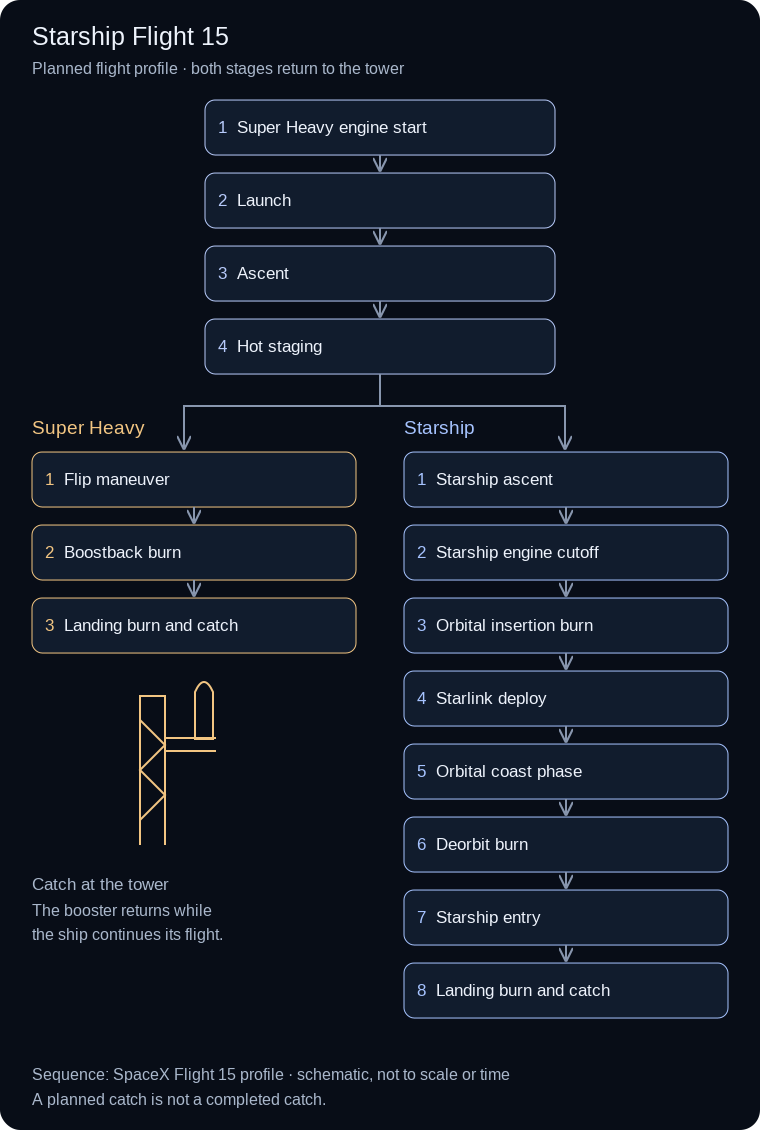
The plan is to catch both Super Heavy and Starship with the tower arms. A planned catch is not a completed catch. After hot staging the two stages follow separate paths, not one sequence in which the ship waits for the booster.
Read the flight sequence
Shared launch: Super Heavy engine start → Launch → Ascent → Hot staging.
Super Heavy: Flip maneuver → Boostback burn → Landing burn and catch.
Starship: Starship ascent → Starship engine cutoff → Orbital insertion burn → Starlink deploy → Orbital coast phase → Deorbit burn → Starship entry → Landing burn and catch.
Source: SpaceX's Flight 15 flight profile, shared November 8, 2026. SpaceX mission page. This drawing shows the order of events, not flight times, altitudes or a ground track.
Flight 15 plan: Super Heavy engine start, Launch, Ascent and Hot staging. Super Heavy follows Flip maneuver, Boostback burn, then Landing burn and catch. In parallel, Starship follows Starship ascent, Starship engine cutoff, Orbital insertion burn, Starlink deploy, Orbital coast phase, Deorbit burn, Starship entry, then Landing burn and catch. Both catches are planned, not completed. The animation compresses these parallel paths and is not a ground-track or timing prediction. sizes: booster 70 m, ship 50 m, full stack 120 m, tower 145 m. tap a phase or drag to scrub.
2. google's space data center is online, and it writes poetry
orbital compute
reported google's project suncatcher prototype finished about three weeks of commissioning and took its first prompt this week. it carries four tpus and makes up to 1 kw of power, so it can run one chip for only about 20 minutes at a time. first ask to gemma 4 on board: a haiku about being in space. the real test is how the chips handle radiation and heat.
target two more satellites in 2027 with more power and laser links between them.
reported also this week: on oct 26 cowboy space unveiled big iron, an 86 m methalox rocket aiming for a first flight in late 2028. the plan is 20,000 satellites at about 1 mw of compute each, one per launch. satlyt showed its software can plan compute jobs across a simulated four-computer network from one computer in orbit.
reported two starlink batches of 27 flew from vandenberg: group 15-16 on oct 27 (booster b1082, 26th flight) and group 15-18 at 9:04 p.m. pdt oct 30 (b1093, 18th flight). the second one was falcon 9's 700th launch.
reported jonathan mcdowell's oct 29 count: 11,190 starlinks in orbit, 11,176 working. spaceflight now notes spacex's pace fell below 150 orbital launches in a 365-day window for the first time since july 2025, down from a peak of 171. florida starlink flights on falcon 9 stopped in august, with starship meant to pick those up.
reported the sls core stage for artemis iii is now mated with its two side boosters inside the vehicle assembly building. next is rollout to pad 39b for a fueling test and countdown rehearsal.
target artemis iii in summer 2027: four astronauts in low earth orbit practicing docking with test versions of blue origin's and spacex's landers. the first landing moves to artemis iv in 2028, and nasa hasn't picked which lander carries that crew.
reported nasa's safety advisory panel pushed back on oct 22 on requiring just one uncrewed landing per lander before crews fly.
sources: central florida public media, 10/30/2026 · nasa, 10/23/2026 · aviation week, 10/2026 · orbitalhub (citing spacepolicyonline), 10/30/2026
5. japan: mmx starts checkout, and h3 hits 80%
japanmars moons
reported mmx is stable on power, temperature and comms, and now spends about three months checking out its instruments. it launched at 4,480 kg, about two thirds of it propellant. the h3 that carried it was the first h3 to launch with no delay, and made the rocket 8 for 10, three in a row. jaxa's mmx blog posted its launch-day story on oct 30.
target mars orbit insertion in aug 2027, a one-shot burn with no second try.
reported on deck: iqps's radar satellite qps-sar-20 "wadatsumi-ii" is set to fly on rocket lab's electron no earlier than 1:30 a.m. jst nov 3 (11:30 a.m. et nov 2).
a few real words from the people doing the work, straight from the source.
blue marble below data streams in silent grace starlight feeds my core. ✨
gemma 4, aboard the suncatcher prototype, its first answer from orbit, as published by google, 10/30/2026 · google blog
"A ‘hello world’ milestone for Project Suncatcher 🚀 ... we’ve now successfully sent a command up to orbit, booted up the TPU, ran the prompt, and received our first complete response back on earth - a haiku!"
the prompt "Write a haiku from the perspective of a TPU orbiting Earth, with the wonderful world spinning beneath you."
the response "Blue marble below, Data streams in silent grace, Starlight feeds my core. ✨"
both as shown on screen in the video in that post.
"The next phase of Project Suncatcher is scheduled for 2027. We’ll send two satellites into orbit to test whether we can perform AI computations distributed across multiple satellites so that we can one day run more complex workloads."
spacex: cargo flights "start no earlier than 2028" · spacex · space.com
where nasa and spacex differ: isaacman sets the order. blue origin flies first on artemis iii ("We're not going to launch without Blue Origin in it", nasaspaceflight, 10/2026), and his 2028 landing target leans on spacex hitting an uncrewed landing by q4 2027 with no refueling demo flown yet.